Results: 74501 books
Sort By:
NewTrending

A Study of Splashes

A. M. (Arthur Mason) Worthington

"A Study of Splashes" by A. M. Worthington is a scientific publication written in the early 20th century. The book explores the behavior of liquid splashes through a series of photographic experiments, particularly focusing on how various factors such as drop size and fluid viscosity influence splash formations. Worthington takes a meticulous approach to examining the phenomena observed, presenting both qualitative and quantitative analyses. The opening of the work introduces the author’s motivation for studying splashes and the method of using instantaneous photography to capture the dynamics of liquid behavior. It discusses the challenges faced in photographing splashes due to their rapid changes in form and the innovative techniques devised to overcome these obstacles. The author conveys his enthusiasm for the beauty and complexity of splashes, inviting readers to appreciate the elegance of natural phenomena that are often overlooked in everyday life. (This is an automatically generated summary.)

Memoranda on Poisons

Thomas Hawkes Tanner

"Memoranda on Poisons" by Thomas Hawkes Tanner is a scientific publication written in the late 19th century. This work serves as a comprehensive guide to toxicology, providing essential information for medical practitioners and students on the properties, effects, classifications, and treatment of various poisons. The content aims to enhance understanding and responsiveness in cases of poisoning, highlighting potential symptoms and antidotes. At the start of the book, the author outlines the nature and modes of action of poisons, emphasizing their variety and complexities. Tanner discusses the difficulties in defining what constitutes a poison, noting that many substances can be harmful at improper doses. The opening chapters also provide a preliminary classification system for poisons and begin detailing the diagnosis of poisoning, elaborating on the responsibilities that fall to medical professionals when dealing with such emergencies. Overall, the beginning sets the stage for a detailed yet accessible exploration of poisons and their implications in medical practice. (This is an automatically generated summary.)

The Toy Shop: A Romantic Story of Lincoln the Man

Margarita Spalding Gerry

"The Toy Shop: A Romantic Story of Lincoln the Man" by Margarita Spalding Gerry is a historical fiction novel written in the early 20th century. The book explores the life of Abraham Lincoln through a unique lens, highlighting themes of childhood innocence and the weight of leadership during wartime. It intertwines a narrative around a toy shop and its owner with Lincoln’s reflections and struggles as a leader. The story centers on a tall man, who is later revealed to be Abraham Lincoln, as he grapples with the burdens of war and leadership. In his search for solace, he ventures into a toy shop owned by Joseph Schotz, a wounded former soldier who crafts toys despite his own suffering. Throughout their interactions, Lincoln reflects on his responsibilities and the sacrifices of young soldiers while finding moments of joy through the innocence of toys. As he buys toy soldiers for his son, the narrative reveals Lincoln's inner turmoil and desire for peace. The climax of the story coincides with the end of the Civil War, reinforcing themes of hope and healing alongside the bittersweet nature of loss, illustrating the connection between the simplicity of childhood and the complexities of adult responsibilities. (This is an automatically generated summary.)
Early American Plays, 1714-1830 - A Compilation of the Titles of Plays and Dramatic Poems Written by Authors Born in or Residing in North America Previous to 1830

Oscar Wegelin

"Early American Plays, 1714-1830" by Oscar Wegelin is a historical compilation of titles and brief descriptions of dramatic works written by authors connected to North America before 1830. The work serves as a window into the early American theater scene, showcasing the emergence of drama during a significant period in the nation’s history shortly after its founding. Its focus is primarily on the cataloging of various plays, many of which reflect the political and social currents of the time. The opening of this compilation presents a preface that contextualizes the significance of early American plays, emphasizing that while many may lack literary merit, they are invaluable for understanding the historical landscape of American theater. Wegelin notes the importance of works like Robert Hunter's "Androboros", the first known play written in America, and highlights the connection between dramatic art and major national events, such as the Revolutionary War. The section includes references to notable names and titles, setting the stage for a rich exploration of dramatic literature crafted by a diverse group of writers who were often also active in other fields, thus painting a broad picture of the early cultural landscape in America. (This is an automatically generated summary.)
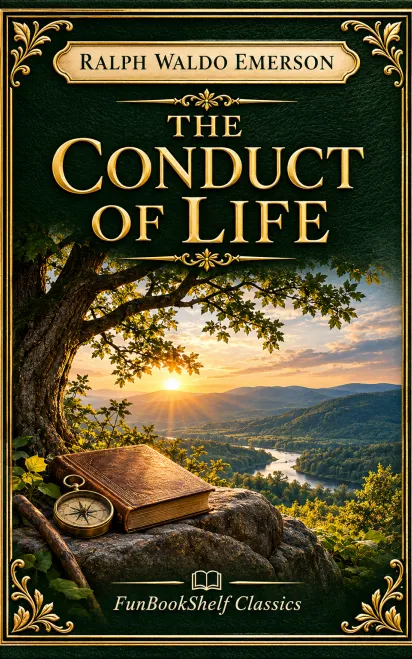
Book cover of "The Conduct of Life"

The Conduct of Life

Ralph Waldo Emerson

"The Conduct of Life" by Ralph Waldo Emerson is a philosophical essay written in the mid-19th century. The work explores fundamental questions about human existence and the principles guiding one's life, particularly emphasizing the relationship between fate, power, and individual agency. Emerson seeks to harmonize the duality between fate and freedom, positing that while individual circumstances may constrain one's life, there is also a profound capacity for self-determination and personal growth. At the start of the essay, Emerson introduces "Fate" as a theme, discussing the limitations and challenges that individuals face in life, such as personal and societal pressures. He reflects on the existing conditions of human morality, individual will, and the influence of nature, advocating that true conduct in life necessitates a deep understanding of one's limitations while harnessing the individual's inner strength. The opening suggests that understanding one's existence and navigating life's complexities is not merely a philosophical exercise but a vital necessity for personal transformation and societal progress. (This is an automatically generated summary.)

The Trial of Callista Blake

Edgar Pangborn

"The Trial of Callista Blake" by Edgar Pangborn is a novel written in the early 1960s. The book delves into the complexities of a high-stakes murder trial where the defendant, Callista Blake, faces serious charges surrounding the death of Ann Doherty, painting a vivid picture of personal and societal conflicts. Through the lens of the courtroom drama, it introduces Judge Terence Mann, who grapples with his responsibilities while confronting the intricacies of human morality and law. The opening of the novel sets the stage in a courtroom on the brink of a sensational trial, as Judge Mann prepares to preside over "The People vs. Blake." The narrative introduces a variety of characters including the key players: the determined Judge, the defense attorney Cecil Warner, and the accused, Callista Blake, a troubled young woman marked by physical deformities and the weight of public scrutiny. The courtroom buzzes with anticipation fueled by media sensationalism surrounding the case, which involves allegations of poison and drowning, and touches upon themes of jealousy and human emotion. Callista’s complex character is hinted at through her deformed appearance and her tumultuous past, as the judge reflects on the societal implications of the trial and the questions of justice that it raises. (This is an automatically generated summary.)

La coucaratcha (III/III)

Eugène Sue

"La Coucaratcha (III/III)" by Eugène Sue is a novel written in the mid-19th century. The narrative delves into emotional and societal struggles, particularly through the experiences of the main character, Cécile, as she grapples with her feelings of isolation and despair within her marriage to Monsieur de Noirville. The book touches on themes of personal suffering, friendship, and the contrasts between external appearances and internal turmoil. At the start of the novel, Cécile writes a heartfelt letter to her friend, the baronne Sarah d'Herlmann, expressing her sense of loneliness and despair following the loss of her family. As she reminisces about happier times spent together, Cécile reveals her distressing reality, feeling trapped in a relationship that brings her more pain than happiness. She vividly describes the emotional torment inflicted by her husband, who remains oblivious to her suffering. The narrative highlights Cécile's profound longing for understanding and connection, setting the stage for her internal struggle against societal expectations and her own feelings of entrapment. (This is an automatically generated summary.)

Miss Dividends: A Novel

Archibald Clavering Gunter

"Miss Dividends: A Novel" by Archibald Clavering Gunter is a fictional work written in the late 19th century. This novel appears to delve into themes of romance, social status, and the contrasting worlds of East and West in America, focusing on the central characters of Erma Travenion and Captain Harry Storey Lawrence. As the story unfolds, it sets the stage for the exploration of relationships amidst the backdrop of New York society and the frontier. At the start of the novel, we are introduced to Captain Harry Storey Lawrence, recently returned from a year in a Southern Utah mining camp, who is enchanted by the refined beauty of Erma Travenion. Lawrence, in pursuit of a business transaction involving a silver mine, becomes smitten with Erma during a supper in New York, where their paths cross serendipitously. The opening chapters establish the contrasting characters of Lawrence, a rugged and determined Westerner, and Erma, an heiress known as "Miss Dividends," as they navigate social dynamics and personal ambitions against the backdrop of shifting societal norms and personal aspirations. Their interactions hint at the complexity of love, ambition, and the societal expectations that shape everyone's destinies. (This is an automatically generated summary.)

History of the National Flag of the United States of America

Schuyler Hamilton

"History of the National Flag of the United States of America" by Schuyler Hamilton is a historical account written in the mid-19th century. The book delves into the origins, significance, and evolution of the national flag of the United States, tracing its development from earlier symbols and standards used during the Revolutionary War. Hamilton's work aims to elucidate the importance of the flag as a symbol of unity and a representation of the ideals held by the nation's founders. The opening of the book begins with a dedication to Major-General Winfield Scott, establishing the respect for military service during the time. It outlines the findings on the origins of the national flag's design, noting a common misconception linking it to General Washington's coat of arms. The author quickly sets a scholarly tone, indicating that the narrative will combine historical documents and accounts to form a cohesive argument about the flag's meaning. Hamilton emphasizes the idea that the flag serves as a powerful emblem of unity for the American people, reflecting the sentiments of independence and national identity that emerged during the founding of the United States. (This is an automatically generated summary.)

Tics and Their Treatment

Henry Meige

"Tics and Their Treatment" by Henry Meige and E. Feindel is a scientific publication written in the early 20th century. The work delves into the clinical observations and treatment methods associated with tics, which are involuntary movements or sounds often overlooked in medical literature. The authors aim to elevate the understanding of tics from trivial movements to serious medical concerns deserving of thorough investigation and intervention. The opening of the book introduces a patient, O., whose case serves as a comprehensive example of tic manifestations and their origins. It recounts his struggle with various tics that began in childhood, illustrating how these involuntary actions are connected to psychological states and habitual responses. O. provides insightful self-observations regarding the onset and progression of his tics, reflecting on the interplay between conscious desire and involuntary actions, while also discussing familial patterns of tics within his family history. This rich narrative sets the stage for a deeper exploration of the medical and psychological implications of tics in subsequent chapters. (This is an automatically generated summary.)

From the Five Rivers

Flora Annie Webster Steel

"From the Five Rivers" by Flora Annie Steel is a novel written in the late 19th century. Set in a rural village in India, the narrative revolves around Gunesh Chund, the head-man, as he grapples with traditional societal expectations regarding family, gender roles, and lineage. The story invites readers into a nuanced exploration of the intersection between personal desires and cultural norms. At the start of the book, we meet Gunesh Chund, who is anxiously awaiting the birth of his child amid the dark, starry night. His thoughts reveal his deep-rooted longing for a son to inherit his position and carry on his legacy. However, his hopes lead to disappointment when his firstborn turns out to be a girl, Nihâli. This opening portion sets the stage for the unfolding drama between Gunesh, his expectations, and the tensions with his mother and wife, Veru. As Gunesh navigates the complexities of fatherhood, societal pressures, and familial acclamation in a patriarchal society, the story probes deeper themes of love, grief, and the harsh realities of life. (This is an automatically generated summary.)

Mollie and the Unwiseman

John Kendrick Bangs

"Mollie and the Unwiseman" by John Kendrick Bangs is a children's novel written in the early 20th century. The story features a little girl named Mollie and her whimsical interactions with a quirky character known as the Unwiseman, who is full of nonsensical ideas and peculiar logic. The narrative takes readers on imaginative adventures that explore themes of curiosity, friendship, and the joy of playful absurdity. The opening of the novel introduces Mollie after a day of playing, where she encounters a sobbing shepherdess named Bopeep who has lost her sheep. Mollie, along with her rubber doll Whistlebinkie and her other doll Flaxilocks, decides to help Bopeep find her lost sheep, leading them to the Unwiseman. The Unwiseman, depicted as an amusingly clueless character, gives nonsensical responses to their inquiries about the missing sheep, further establishing his role as a source of humorous confusion. As the story unfolds, it promises whimsical interactions, odd adventures, and the charming dynamics between Mollie and her doll companions, making it an enchanting read for children. (This is an automatically generated summary.)

The Expositor's Bible: Index

S. G. (Samuel Gardiner) Ayres

"The Expositor's Bible: Index" by S. G. Ayres is a comprehensive reference work created to accompany the Expositor's Bible series, published in the early 20th century. This index systematically organizes a wealth of information across the volumes of the series, serving as a vital tool for scholars, theologians, and lay readers who seek to deepen their understanding of the Bible. The book likely covers both the Old and New Testaments, with detailed entries that connect various biblical themes, characters, and passages. The opening portion of the index provides a detailed structure for navigating the extensive content of the Expositor's Bible, highlighting its aim to make the biblical text accessible and comprehensible. It emphasizes the significance of having a well-organized index that allows readers to locate discussions about specific characters, themes, and scriptural passages, effectively demonstrating how the individual parts of the Bible interconnect. The introduction sets a scholarly tone, underlining the importance of biblical criticism and interpretation in understanding the Scriptures, and the need for a resource like this index to guide readers through the multifaceted discussions presented throughout the Expositor's Bible series. (This is an automatically generated summary.)

A Catalogue of Books for the Young

Okeden & Welsh Griffith, Farran

"A Catalogue of Books for the Young" by Griffith and E.P. Dutton (Firm) is a detailed listing of children's literature, likely compiled during the late 19th century. This catalog functions as a resource for parents and educators, showcasing a variety of book options arranged by price, making it easy to choose suitable gifts or school prizes for young readers. The likely topic of this book centers around the promotion of children's literature and educational materials. The catalogue presents a comprehensive range of books suitable for different age groups and interests, featuring titles that include adventure stories, educational texts, and illustrated works. Each entry provides information on the book's price as well as descriptions of its content, highlighting the authors and illustrators involved. Whether it’s stories about naval adventures, tales from fairyland, or books that instill virtues and morals, this collection aims to inspire a love for reading among youth, offering something for every child's taste. (This is an automatically generated summary.)

The Age of Dryden

Richard Garnett

"The Age of Dryden" by Richard Garnett is a scholarly historical account written in the late 19th century. This work belongs to a series that provides a comprehensive history of English literature, focusing specifically on the literary developments during the Restoration period, roughly spanning the years 1660 to 1700. The book notably centers around the life and contributions of John Dryden, a significant figure in English poetry and drama during this transformative era in literature. The beginning of "The Age of Dryden" introduces the overarching theme of how the restoration of Charles II marked a revolution not only in the political sphere but also in literary endeavors. It discusses the transition from the styles and philosophies of the previous literary generation, notably influenced by the Civil War, to a new era characterized by a distinct clarity and logic in writing. The text hints at the broader context of Dryden's emergence as a poet, as well as the literary innovations that took place during the latter part of the 17th century, establishing a foundation for understanding the evolution of English prose and poetry that followed. This historical lens serves as a backdrop for examining the changing tides of literary fashion and the key figures that drove these changes, offering readers insight into the era’s complexities. (This is an automatically generated summary.)

Macchiavellis Buch vom Fürsten

Niccolò Machiavelli

"Macchiavellis Buch vom Fürsten" by Niccolò Machiavelli is a political treatise written in the early 16th century. This influential work explores the nature of power and sovereignty, providing pragmatic advice for rulers on how to acquire and maintain authority. The book is often associated with the concept of realpolitik and has sparked extensive debate regarding its moral implications. At the start of the book, Machiavelli sets the stage by addressing the various forms of governance, distinguishing between hereditary principalities and new acquisitions. He lays the groundwork for his exploration of political power, emphasizing that rulers must understand the dynamics of their states and the intricacies of human nature in order to govern effectively. Machiavelli's intention is clear: to offer practical guidance based on historical examples and personal experiences, ultimately revealing the complex relationship between power, morality, and leadership. (This is an automatically generated summary.)

My Fire Opal, and Other Tales

Sarah Warner Brooks

"My Fire Opal and Other Tales" by Sarah Warner Brooks is a collection of short stories written in the late 19th century. The book explores themes of humanity, morality, and redemption, primarily focusing on the lives of individuals in and out of prison. The narrator often reflects on the complexities of human nature, and the profound impact of kindness and understanding on those who society has deemed unworthy. At the start of the collection, the reader is introduced to a character named Isabel, who prepares for a period of solitude at home while her husband goes away. As she navigates her fears and insecurities—particularly about being alone in their house—Isabel's thoughts reveal her humorous yet fraught perspective on domestic life. This charming vignette sets the tone for the tales to come, which likely delve deeper into human connections and the struggles of those who find themselves in the shadows of society, including prisoners and their relationships with outsiders. The opening suggests that the stories will be both relatable and thought-provoking, inviting readers to consider the nuances of compassion and humanity. (This is an automatically generated summary.)

The Church on the changing frontier : a study of the homesteader and his church

Helen Olive Belknap

"The Church on the Changing Frontier: A Study of the Homesteader and His Church" by Helen O. Belknap is a historical account written in the early 20th century. This work explores the dynamics of Protestant churches in rural areas, particularly in four counties across the Rocky Mountain States—Beaverhead in Montana, Sheridan in Wyoming, Hughes in South Dakota, and Union in New Mexico. The book investigates how changing social, economic, and environmental factors have influenced the church's role and effectiveness in these regions, providing a glimpse into the intersection of faith and pioneer life. The opening of the book sets the stage for a comprehensive study of the Protestant church's presence and function in the rural American West. It introduces the challenges faced by churches in vast, sparsely populated areas where many residents are transient homesteaders. Belknap outlines the historical context of each of the four counties, detailing their geography, settlement patterns, and demographic trends. She emphasizes the impact of economic pressures and social changes on church life, amidst a backdrop of community dynamics shaped by cooperation and occasional conflict. This early section establishes an analytical framework for the detailed surveys and discussions that follow in later chapters, aiming to present a nuanced view of the church’s roots and ongoing evolution in response to a rapidly changing frontier society. (This is an automatically generated summary.)

A Sovereign Remedy

Flora Annie Webster Steel

"A Sovereign Remedy" by Flora Annie Steel is a novel written in the early 20th century. The story begins with a humorous encounter between two young men, both named Edward Cruttenden, who collide while cycling in the picturesque Welsh landscape. Their meeting sparks a conversation about their similar backgrounds, as they both share the experience of being orphaned and from different social standings, highlighting the apparent randomness of wealth and privilege. At the start of the narrative, the two Edwards become immediate friends as they discover their shared name and engage in light banter about their lives. After their collision, they find themselves resting by a pool, discussing their circumstances, including the topic of money and class differences. A moment of camaraderie is interrupted by the arrival of others, including a clergyman and a doctor, each of whom brings their perspectives on wealth and its implications. The opening sets a conversational tone, leading to themes of social status, personal identity, and the pursuit of happiness amidst life's uncertainties, laying the groundwork for the evolving relationships and adventures that follow. (This is an automatically generated summary.)

The Oriel Window

Mrs. Molesworth

"The Oriel Window" by Mrs. Molesworth is a children's novel written in the late 19th century. The story revolves around a young boy named Ferdy Ross, who is celebrating his ninth birthday when an unfortunate accident changes everything. The narrative explores themes of family, resilience, and the journey of recovery, particularly through the perspective of siblings as Ferdy navigates the challenges brought on by his injury. The opening portion of the book introduces Ferdy as an exceptionally happy young boy, excitedly anticipating his birthday celebrations. We learn about his close relationship with his sister, Chrissie, as they exchange presents and share playful conversation. However, as the day unfolds, a tragic accident occurs when Ferdy falls from his new pony, resulting in a serious injury that shifts the tone from joyful celebration to a poignant story of healing and emotional support. The siblings' deep bond and contrasting personalities begin to play a crucial role in navigating the uncertainties that come with Ferdy’s condition, setting the stage for their growth and development throughout the narrative. (This is an automatically generated summary.)